Reflection on the story of the Good Shepherd
Fourth Sunday of Easter: Psalm 23 & John 1.1-10
Our readings this morning make us reflect on God in the familiar image of the Good Shepherd. Although not many of us still live in a place where shepherding is a common profession, the Biblical stories have become very much part of our Western narrative, even for those who would not call themselves Christians.
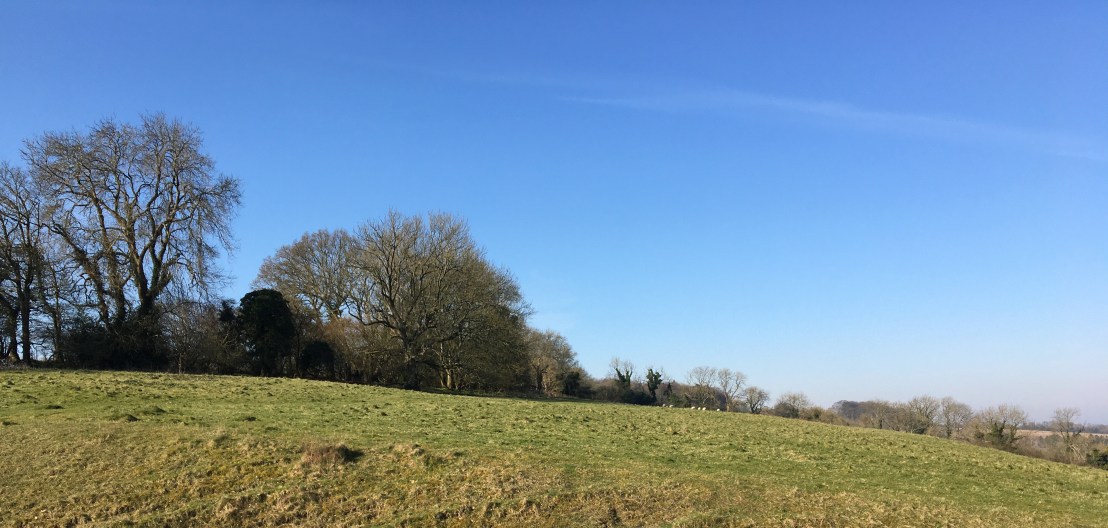
That of course comes with its risks, because the way we imagine a shepherd nowadays, will have been very different from what they may have looked and behaved like two millennia ago. However, I don’t want to dwell on that thought too much, but rather share a story that made me think of the Good Shepherd a few weeks ago. I was out on my daily round of exercise on Granham Hill, just around the corner from where I live. Usually there are sheep roaming around at a distance, and the only interaction between them and me is a curious look at one another.
However, on this particular day, one of the sheep was stuck in some barbed wire. Being reminded of my pastoral profession, I felt a duty to see if there was anything I could do. Slowly I approached the sheep, at the same time not trying to scare it as well as thinking how I would go about freeing it. Whilst I was still at a good distance, the sheep was so shocked by my appearance, that this in itself was enough for it to free itself, and quickly it ran away.

 This morning we hear two very different readings. Paul in his letter to the Colossians speaks in abstract theology about the image of the invisible God. He reflects on Jesus’ divine nature, the Word that was from the beginning and was made flesh. The mystery at the heart of our faith. In our Gospel reading from Luke – the familiar story of Martha and May –, however, we encounter once more the human side of Jesus. The man who was always concerned about others, who spoke with a wisdom which we can still hear today. Indeed, in Paul’s words, that is how the image of the invisible God is displayed: through Christ in all his divinity and all his humanity.
 Recently, I watched the film ‘My name is Khan’, a moving film around religious divisions as well as human goodness. An autistic Muslim man seeks to meet the president of the United States after his stepson is killed in the wake of 9/11. Encountering a range of people as he travels, he holds on to the truth told he was told as a child by his mother: there are only two types of people, those who are good and those who are bad.
 John’s purpose is to articulate the belief that Jesus was the Son of God, who was born in human form, died and rose again. He is trying to understand and to help us understand what it means for the Scriptures to be fulfilled as the Word became flesh. In contrast to some other parts of Scripture, I would like to suggest therefore that the theological background of this particular passage is more important than its historical context, and so that is what I would like to focus on this morning, hoping that it will give us a better appreciation of what Jesus may have meant by that last – easily misinterpreted phrase – ‘You always have the poor with you, but you do not always have me.’
 As some of you reading will know, Marlborough is currently without a Rector. It is a strange thought that the local Church is currently without a leader. However, todays readings remind us that being the local Church, being the Body of Christ in a place, is a responsibility in which we all share. We all have a role to play in the local Christian community, each in our own way, as well as together in relationship.
 The passages from Mark’s Gospel chosen by the compilers of the Lectionary this Sunday, frame the account of the feeding of the five thousand. Hence, we notice that this section has something to say about our human need, and Jesus’ response. So that is what I would like to explore a little further.
 Discovering Life