Sermon St Margaret’s West Hoathly
Maundy Thursday 6 April 2023
Exodus 12.1-14, 1 Corinthians 11.23-36, John 13.1-17, 31b-35
I wonder how far along you are with your Easter preparations? Is there still some planning or shopping to be done, or is everything ready to go? One of the real joys of the Easter weekend is the ability to host or visit family and friends, as not only the schools have broken up, but also for most people it is a four-day weekend. There is something hugely powerful about gathering around the table for a shared meal, and I suspect that this has been the case throughout the generations in virtually every culture.
Jesus and his disciples have arrived in Jerusalem to do the same. They have gathered to celebrate the Passover, one of the most important Jewish festivals. We hear about the origins of the festival in our reading from Exodus. For the Jewish people, the Passover is the time to remember how God struck the land of Egypt, their oppressors, to force Pharaoh’s hand to give the people back their freedom.
For Christian people too, the celebration of Easter is one of freedom from oppression: freedom from the oppression of sin and death. For the Jewish people, on the night of the Passover, their journey into freedom begun. It was a journey that would take them forty years. Although for us Easter is only three days away, if we are to take the story seriously, we too have a journey to make before we can be ready.
What is true for the entirety of the Gospel story, is particularly true for the last few days of Jesus’ life on earth: it is a story that is about us. It is too easy to think that it was Judas who betrayed Jesus, Peter who denied Him, and the Romans who crucified Him. Instead, we need to ask ourselves the question: when did we betray, deny and crucify Jesus?
Trying to answer that question honestly and truthfully is possibly one of the hardest challenges in the Christian life, as it confronts us with our weakness, with the wrong decisions we have made, knowingly and unknowingly, and we might feel utterly unlovable, trapped in a situation of our own making.
I wonder if this is what Judas felt as soon as he knew that he was going to betray Jesus? After his conversations with the authorities, did he feel that there was no way back? And after that faithful kiss, Judas assumed that he was beyond redemption and could no longer live with himself; for him, he felt there was no hope, no way in which he could be free ever again.
Maybe we too know of people who feel like this, who feel that they are beyond redemption? People who have given up on themselves and assume that others will do the same, that indeed God will give up on them too. People who end up in a spiral of self-destruction because they cannot live with what they have done.
For Peter, it was different. Maybe, one could argue that his sin of denial wasn’t as great as Judas’ sin of betrayal. But I don’t think that this was the essential difference between the two of them. I wonder if the greatest difference between Judas and Peter is that Peter could somehow still believe in Jesus’ love for him. That no matter how often he got things wrong, he was able to let Jesus love him, wash his feet, and ultimately forgive him.
For each of us, that is our journey from slavery to freedom. A lifelong journey, but each year particularly acute on these most holy days. It is a journey towards a greater trust in God’s love for us, and with that a greater awareness of our lacking love for him. Our freedom does not lie in always making the right decisions, but our true freedom lies in the knowledge of God’s never-failing love for us.
It is a journey that each of us will have to travel on our own: and each of these journeys will be unique. Yet, that doesn’t mean we have to travel alone. In the last hours of his life, Jesus gives his disciples, gives us a command. It is the reason why today is called Maundy Thursday, after the Latin ‘mandatum’ commandment.

The commandment is this: that you love one another. Just as I have loved you, you also should love one another. And if God’s love for us is hard to accept, so also is it hard to truly accept our love for one another. We see that tonight in our service: it is not easy to have your feet washed, and I have to admit that last year, when I was in the congregation, I did not. Because it makes us vulnerable, because by doing so we are making a statement: I trust you to love me.
Whichever way we spend the next couple of days, whether it’s travelling or preparing to host; whether it’s in Church or at home, I would urge you to find some time away from any distractions and to take a few moments to place yourself in God’s presence. Maybe tonight in the Garden of Gethsemane, or tomorrow at the foot of the Cross.
To bring ourselves into God’s presence. Our frail, vulnerable selves, in the presence of God’s infinite, unconditional love. And to watch and wait, together with the Church throughout the world, so that we too at the end of our journey, might find ourselves redeemed by the risen Christ.


 However, as soon as I arrived, I also knew that this was not, and would never have been, my final destination. A small part of me had hoped to receive a revelation that would put everything in place, that would possibly change me forever, but I knew deep down that this was not what I was looking for. Before I set off, jokingly I said to a colleague: “I may come back a different person”. His reply was: “I hope not”. It was precisely this truth that I needed to discover, but it was only the journey that had made me realise that I wanted to know what I already knew, and was looking for that which I already have.
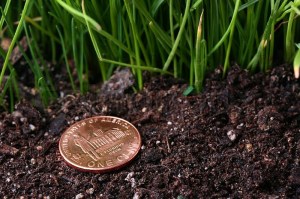 In today’s Gospel reading, Jesus tells us two familiar parables: the lost coin, and the lost sheep. Deliberately trying to provoke, or at least to startle, He starts by saying “Which one of you would not …”. I’m not sure about you, but when I’ve lost something not so essential, I usually just wait for it to turn up again. If I can’t find the pen I was using, I’ll grab another one lying around. Unlike the woman in our reading this morning, I would certainly not spend hours looking for a missing coin, if I had nine others lying around.
 In
In For some of us, Lent seems to have turned into an opportunity to prove ourselves. Consciously or not, we can find ourselves competing against others – how many food groups can you give up? Or, maybe more commonly, we realise that we are competing against ourselves – how much time can I spend praying, reading and studying? How much good can I do in one day?
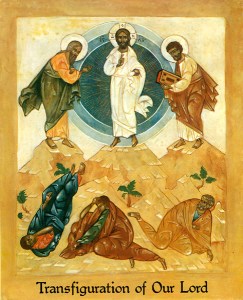 On this last Sunday before Lent, we traditionally hear the account of Jesus’ transfiguration before his disciples. It has strong resonances with the account of Moses receiving the Ten Commandments on Mount Sinai, and it is a few of those I would like to explore this morning.
 Discovering Life