Sermon 3rd November 2019, All Saints’ Church Stanton St Bernard
All Saints’ Sunday: Ephesians 1.11-end, Luke 6.20-31
Today the Church celebrates All Saints’ Sunday, so it is lovely to be here with you in All Saints’ Church. When I took a school assembly for All Saints Day last week, I asked the children how they thought that they might recognise a saint. The first answer was that saints may be dressed in robes, which is a fair point if we look at a lot of traditional paintings and artwork. The second answer was that a saint is someone who does ‘good’ for other people. Maybe my favourite one was someone who answered that you could ask the person themselves. Although I’m not sure what a person would need to say to convince me.

Of course the question, in a way, was the wrong one to begin with, as the most accurate Christian definition of a saint is someone who the Church trusts to be in heaven after having lived a holy and virtuous life. So that means we can only know who were saints in their life-time, not those who are. Continue reading “Be a blessing to others”


 When I was asked recently what I had been reading theologically, I had to admit that most of the books I read over the summer had been novels. Some were recommended by friends, others I had picked up because they looked interesting and not too heavy for a summer’s evening. I don’t think that was the expected answer, but I suspect I have learnt at least as much from reading good fiction as I have gained understanding by reading more academic works.
 If you feel that this morning’s parable in Luke’s Gospel is a little bit confusing, you are certainly not the only one. For centuries, Christian theologians have been puzzled by the structure and meaning of the story of the dishonest manager. I even consulted my German compendium on Jesus’ parables, which doesn’t happen very often, witnessed by the eight-year old bookmark I found … Some themes are obvious: the parable has something to do with honesty and our attitude to wealth, but its overall message is by no means entirely clear.
 In today’s Gospel reading, Jesus tells us two familiar parables: the lost coin, and the lost sheep. Deliberately trying to provoke, or at least to startle, He starts by saying “Which one of you would not …”. I’m not sure about you, but when I’ve lost something not so essential, I usually just wait for it to turn up again. If I can’t find the pen I was using, I’ll grab another one lying around. Unlike the woman in our reading this morning, I would certainly not spend hours looking for a missing coin, if I had nine others lying around.
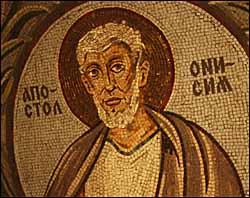 Paul’s letter to Philemon, which we hear this morning, is one of the shortest books of the Bible. We have just heard most of it, apart from the final few verses. Most scholars agree that the letter is authentic and written by Paul in prison, either in Ephesus or in Rome.
 I have to admit and apologise that this week my mind has been not so much on preparing a sermon for Sunday, but I have been preoccupied with finalising the arrangements for the Get There! holiday club. Both of these problems, of course, could have been solved by better and more thorough planning, but equally, it was a good distraction from what is happening politically at the moment.
 Given this morning’s readings, it would be so much easier if I was able to preach a good ‘fire and brimstone’ sermon. Ten minutes, or maybe more like twenty-five minutes of telling you how it is clear that we are a doomed generation and that God’s wrath is waiting for us. However, despite a promising start in the more conservative circles of the Dutch Reformed Church, my experience of God has been one of a God who loves us, and who gives us hope, strength and comfort when we most need it.
 Discovering Life