Holy Trinity Church Hurstpierpoint
Sunday 9 May 2021, Easter 6 and Christian Aid Sunday
Acts 10.44-48 & John 15.9-17

Today is Christian Aid Sunday, the start of Christian Aid Week. Many of you will remember receiving of giving out envelopes as part of the annual fundraising campaign. Christian Aid was founded in 1945 by British and Irish churches to help refugees following the Second World War, and have supported poor communities worldwide ever since, not just by bringing practical relief, but also by campaigning for fairness and justice.
Currently, the main focus of their work is combatting our climate crisis and its consequences, as well as trying to protect the most vulnerable in the world against the devasting effects of the global pandemic. Their work is not party-political, but shows that to be a Christian is to care about those whose plight is greatest.
That brings us straight to our readings this morning. The reading from the Acts of the Apostles, in which we hear of the universality of God’s love; and the passage from John’s Gospel, part of Jesus’ Farewell Discourse, for me possibly one of the most moving parts of Scripture, so that is where I would like to start.
The passage follows directly the reading we heard last week, in which Jesus spoke of the vine and its branches. Many scholars agree that these two readings are one unit, in which today’s passage is a commentary on what it means to be the branches of the true and living vine, what it means to abide in God’s love and how we do this.
Jesus summons us firstly to keep his commandments: “If you keep my commandments, you will abide in my love (…) so that my joy may be in you, and that your joy may be complete.” These commandments are not there for God’s sake, but for ours.
In an increasingly secular world, more and more people are astounded that people are still willing to commit to a religion and follow the laws that come with that. Why would you voluntary submit yourself to an authority who puts restrictions on your life? The answer lies in this passage: these commandments are not limiting our freedom, but they are here to make our joy complete, to set us free; free to bear fruit.
The greatest of these commandments, we hear once more today, is to love one another, as Christ has loved us. These words too challenge a modern, secular perception of religion: that it is all about trying to appease God, that we are here in Church trying to be ‘good’ people, so that God may love us.
No, it is exactly the other way around: God’s love comes first, and we are asked to respond in love towards one another. There is nothing we can do to deserve God’s love for us, that love has already been given; God’s love is unconditional. All that we do is a response to that unconditional love: that is what it means to abide in Him.
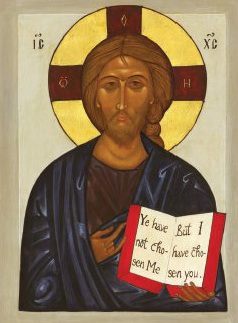
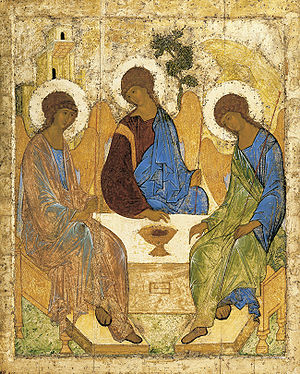
This idea of our response, rather than our initiative resonates throughout today’s passage from John. “You did not choose me, but I chose you” – again, it is God’s initiative, our response. When I was training for ministry, this was the text that accompanied the icon in our Chapel, and as we prepared for our ordained life, we were asked to reflect on what it meant to bear fruit that will last. “And I appointed you to go and bear fruit, fruit that will last.”
Before asking ourselves that question this morning, what does it mean for us to bear lasting fruit, I would like to come back to the fact that it is Christian Aid Sunday. Therefore, before looking at ourselves, I would like to think about what this question might mean for the women in Burkina Faso, for example, who risk their lives on a daily basis just to get clean water for their families and children? God chose her, as much as he chose you or me, to go and bear fruit, fruit that will last.
Or how would these words be heard by the many children recently orphaned in India? How, amidst the pain, suffering and loss, do they hear God’s call? How will they be able to experience that complete joy of which we hear today?
Those are challenging questions, and I know that I am one of those people who doesn’t ask myself that question often enough. However, the only way in which we ourselves can bear fruit is by helping others to do the same. We cannot claim a life fully lived if we have forgotten those around us. We cannot claim that the global pandemic is over until everyone will be able to receive the vaccines and the treatments that are available to us. We cannot claim that we have solved the climate crisis, as long as others are still at risk of devastating droughts and floods, without access to clean water and food.
As Christians, we believe that each person is made in God’s image. That God’s unconditional love is given to each of us. “The gift of the Holy Spirit had been poured out even on the Gentiles”, as we hear in the Acts of the Apostles. “Even on the Gentiles”, those people so unlike those who were associated with a proper and good life; those people so unlike those with whom we share our lives. Even they have received that gift of the Holy Spirit, even they are appointed to go and bear fruit, fruit that will last.
The risk of saying all these things is that we feel guilty about what we have and what others don’t. That we feel guilty when we receive a vaccine, or when we enjoy a lovely meal or a holiday abroad. Or that we get angry at those who seem to criticise our choices. But that’s going back to the idea that we deserve, or need to earn, what we have. Instead, what we need to realise is that all that we have, has been given to us in the first place. It is our response that matters.
Being able to give, being able to share is the privilege we have, we all have. But it looks different for each of us. The women in Burkina Faso, the children in India, the people of Holy Trinity Hurstpierpoint, we have all got something to give, something to share. Our job is to find out what it is we have to give, as individuals, but also acknowledging our common humanity.
Giving is not about just putting some money in an envelope, although it can certainly be part of it. Giving may also be giving of our time and skill; giving something up so that someone else may have it. Sharing our experience and wisdom with the next generations: there are countless examples of how we can give.
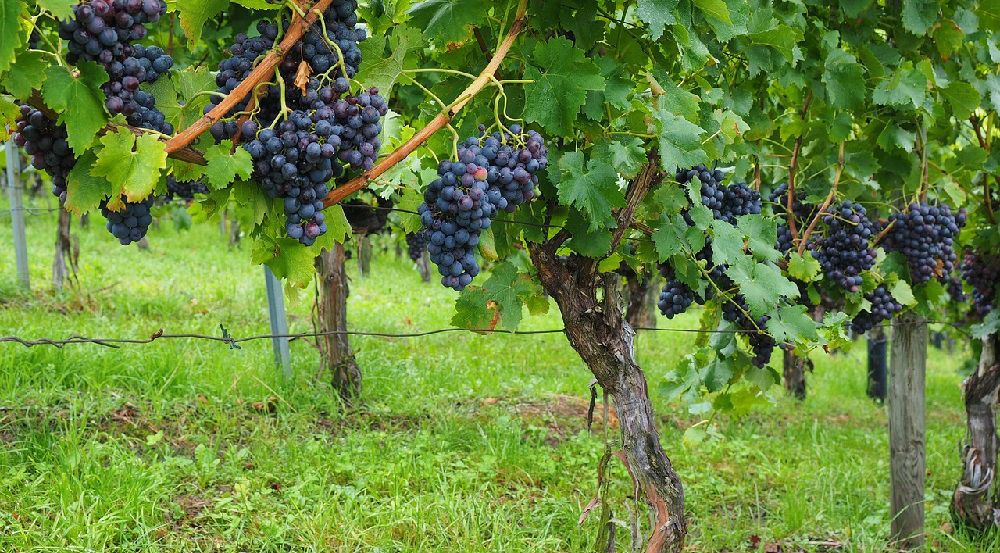
What they all have in common is that in that giving, we give something of ourselves: it makes a difference, not just to the recipient, but also to us. To go back to the image of the vine and its branches: in giving, in sharing, we allow ourselves to be pruned. Not by cutting into the living branches, but by finding out those that need to be cut for us to bear real, lasting fruit. That’s something we often only really find out when we try, when we take that step that comes at a cost. Only then can we be truly free and truly bear fruit and truly be the people God chose and made us to be.

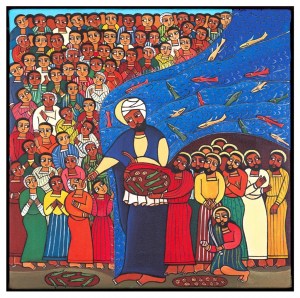 When I hear the story of the Feeding of the 5000, immediately the image of an All Age service a few years comes to mind. The Open the Book team acted out the story of the ‘Marvellous Picnic’, and I remember the discussions on the logistics of how the bread should miraculously be multiplied after Jesus – a role impressively played by Anna – blessed the loaves and broke the bread.
 The challenge that Jesus puts before us as he speaks to the Samaritan woman is timely for us: those who drink of the water that I will give you, will never be thirsty again. Surely, this is going too far; surely now our focus should be on ourselves and our own safety? Or do we dare to be challenged and think what it may look like for us to leave our water-jars at the well to go and tell people about the living water? So this morning, I would like to think a little bit about how we can have a genuinely Christian response to our crisis. It comes with a disclaimer: it is no official health advice, but rather food for thought in these challenging times.
 Today we are joining people throughout our nation to mark Remembrance Sunday. In our Act of Remembrance that follows this Communion service, we bring to mind those who have lost their lives fighting for peace and freedom. As we hear the names of those of this parish who died during the two Great Wars, we are once more reminded of the scale of loss that this country, and other nations, suffered.
 I have to admit and apologise that this week my mind has been not so much on preparing a sermon for Sunday, but I have been preoccupied with finalising the arrangements for the Get There! holiday club. Both of these problems, of course, could have been solved by better and more thorough planning, but equally, it was a good distraction from what is happening politically at the moment.
 John’s purpose is to articulate the belief that Jesus was the Son of God, who was born in human form, died and rose again. He is trying to understand and to help us understand what it means for the Scriptures to be fulfilled as the Word became flesh. In contrast to some other parts of Scripture, I would like to suggest therefore that the theological background of this particular passage is more important than its historical context, and so that is what I would like to focus on this morning, hoping that it will give us a better appreciation of what Jesus may have meant by that last – easily misinterpreted phrase – ‘You always have the poor with you, but you do not always have me.’
 It has been estimated during those thirty years of the Troubles that over 3,500 people were killed. That number made me realise that the scale of the recent violence in London is not very different, with already over fifty murders in the first three months of this year. Whereas in Northern Ireland, the conflict has been very much associated with Christianity, the violence in London seems to be of a different nature. This, I suspect, is not unrelated to the fact that Christianity in Ireland is still much more prominent than it is in our capital city nowadays.
 Discovering Life