The second reflection on the nature of friendship looks into the fact that even our closest friends have their limitations, just as we ourselves do.
 The story of Job is familiar to many, and has been seen an attempt to answer the question of why there is seemingly purposeless suffering. On the surface, the narrative looks like a simple story, in which Job is a pawn in the eternal battle of Good and Evil. However, there is much more to be said, and for example Eleonore Stump gives an excellent in-depth exploration of the theme of suffering in Job in her book Wandering in Darkness.
In the following, I would like to turn our focus away from Job himself towards his friends: Eliphaz, Bildad and Zophar. When they hear that Job is struck by suffering, together they go and try to console and comfort him – indeed the sign of a true friend. Before anyone says anything, they sit together in silence for seven days and seven nights, and maybe they should have left it there. Job himself is the first to speak. Although he curses the day that he was born, he does not blame anyone for his misery: not himself, nor God. Although he is looking for an explanation, he does not find fault: he maintains his own innocence, but doesn’t hold God responsible either.
 I remember a Church meeting a few years ago, in which there was a disagreement over the right course of action. I don’t quite remember what the conversation was about, but maybe it was something rather trivial like the colour of painting, or maybe more precisely, the shade of white we were going to use to paint the church hall. It was clear it was hard to find a way forward as too many people had a too passionate opinion about the matter. Until one person said “Well, I have prayed about this and we need to go for ivory white.” So, the decision was made: it is hard to argue with God’s word.
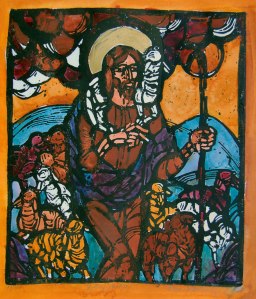 I wonder what you think about the question above; a question that the Jews ask Jesus in our Gospel reading today: is it an unreasonable request? Or is it a question we have asked ourselves at times too? If God exists, why doesn’t he show himself a bit more clearly? It is a question I often hear my pupils asking when we speak about the possibility of the existence of God. Their argument is fair enough: if God is all-powerful and all-loving, why doesn’t he show himself, why does he allow suffering in the world? It is an age-old question, and I don’t think that there is a completely satisfactory answer to it. For me, Jesus’ reply to the Jews this morning may point in the direction in which we may start to look for an answer, but not without difficulty.
 The news over Holy Week and Easter was dominated by two devastating events: the fire at the Notre Dame and the horrendous Easter Day shootings in Sri Lanka. Now, at the beginning of May, both these events seem to have disappeared almost completely from the news head
 Given the fact that we cannot live without water, it is no surprise that in most world religions, including Christianity, water has a major role to play. It can be a threat: both gods and creatures have been thought to hide in seas and lakes, representing the dangers that people experience on sea. The power of gods and God has been shown in having power over water, such as the parting of the Red Sea and Jesus calming the storm.

 Discovering Life