Sermon 29th March 2020 Fifth Sunday of Lent: John 11.1-45
It is hard to believe, but in two weeks’ time it is Easter Sunday. That means that today, liturgically, Passiontide begins. As someone put it, we move from the desert to the Cross. The reading we hear this morning, the raising of Lazarus, has also been called the Easter story in miniature. The more closely one looks, the more parallels can there be drawn between the overarching Gospel narrative and these verses in John’s Gospel.
This morning, I would like to have a look at some of those parallels, particularly those that resonate with the situation in which we find ourselves today. Those of you who know me a little bit, may find it surprising that I am quoting the British Prime Minister, but he was right when he bluntly said ‘It will get worse, before it gets better’.

That it will get worse, before it gets better is precisely what we see in the Easter story too. During Lent, during this Passiontide, the closer we come to Easter, the closer we also come to Good Friday: there is no escape.
 Or are you maybe a little bit like myself? When I start thinking about what I should or would like to change about my life, I easily get overwhelmed. There seems to be so much that I could and should do better, that I don’t even know where to start. Therefore, also this year I have fallen back to my default resolutions: giving up alcohol, praying more and spending more time with God.
 John’s purpose is to articulate the belief that Jesus was the Son of God, who was born in human form, died and rose again. He is trying to understand and to help us understand what it means for the Scriptures to be fulfilled as the Word became flesh. In contrast to some other parts of Scripture, I would like to suggest therefore that the theological background of this particular passage is more important than its historical context, and so that is what I would like to focus on this morning, hoping that it will give us a better appreciation of what Jesus may have meant by that last – easily misinterpreted phrase – ‘You always have the poor with you, but you do not always have me.’
 In
In
 For some of us, Lent seems to have turned into an opportunity to prove ourselves. Consciously or not, we can find ourselves competing against others – how many food groups can you give up? Or, maybe more commonly, we realise that we are competing against ourselves – how much time can I spend praying, reading and studying? How much good can I do in one day?
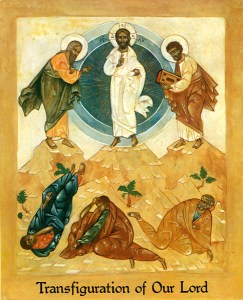 On this last Sunday before Lent, we traditionally hear the account of Jesus’ transfiguration before his disciples. It has strong resonances with the account of Moses receiving the Ten Commandments on Mount Sinai, and it is a few of those I would like to explore this morning.
 In contrast to Advent, it seems to me, where every Sunday we light one more candle until it is Christmas, in Lent, the mood gets darker and darker as we approach the end of the season. Indeed, Good Friday still stands between us and Easter at this point. Personally, I find myself often conflicted in these last weeks before Easter: part of me is eagerly anticipating the joy of the Easter celebration, whilst another part of me knows there is still more work to be done before I am ready to appreciate the fullness of Jesus’ Resurrection. I almost feel like I’m watching a solar eclipse on the horizon: the shadow of Good Friday slowly moving to cover the glory of Easter, only to be seen again in all its fullness when the shadow has passed.
 Discovering Life