A homily for the Second Sunday after Trinity
Galatians 5.1, 13-25 & Luke 9.51-62
 This last weekend of June is traditionally the time at which ordinations take place, as on 29th June the Feast of St Peter and St Paul is celebrated, two of the earliest followers of Christ. In cathedrals across the world, people are committing their lives to a diaconal or priestly ministry, promising before God and others to serve the Church in this particular way. Ordinations are a public commitment to a certain way of life, of discipleship, in a similar way to confirmation and baptism, as well as weddings. What all these services have in common, I think, is that they give everyone an opportunity to celebrate, as well as to reflect on our own unique calling, expressed through the commitments we ourselves have made at various times in our lives.
There are many different ways in which we can think of our own discipleship, often without using that word itself. This morning I would like to focus on one particular aspect, which is also mentioned in our reading from Paul’s letter to the Galatians, and that is our freedom in Christ. Making a commitment seems almost the diametrical opposite of being free, but I would like to suggest that in reality our commitment to God is what enables us to embrace our freedom.
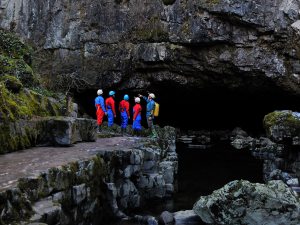 In the Church year, today, the Sunday after Pencecost is known as Trinity Sunday. So, obviously, I have spent most of Shell OA week [a week of outdoor activities in the Brecon Beacons] not thinking about my wet feet, or my wet sleeping bag, or how to make the best hot chocolate for the New Court Shell, but about the best, least boring, way to explain the Trinity this morning. Thus, in the middle of the caves on Thursday, again water-soaked, I realised that maybe there is a comparison to be made between going to Chapel and caving. Hence, as Mr Clark still seems to be employed after comparing Pentecost to Love Island last week, I decided to take the risk. But more about that a bit later.
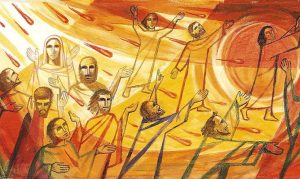 Joy and apprehension, I suspect, is what the disciples may also have felt on that first Pentecost – literally the fiftieth day – when they became filled with the Holy Spirit, and they began to speak in different languages. Both the disciples themselves and those living in Jerusalem were caught by surprise, because although Jesus had promised them the Holy Spirit would come, at the time his followers did not know what this meant or what it would look like. It is also a moment of commitment, both demonstrating God’s loyalty to His people as well as the charge given to his followers to proclaim His message to all people, in all languages.
 This year is the third year in which Churches throughout the world are joining in an initiative called ‘Thy Kingdom Come’. It started in 2016 as an invitation from the Archbishops of Canterbury and York to use the eleven days between Ascension Day and Pentecost as a time to renew our commitment to prayer. Since then, the initiative has grown into a worldwide, ecumenical movement with Churches from over 65 different denominations in 114 countries around the world. One can wonder of course if it is a good thing to even have 65 different denominations, but it shows the scale of the movement.


 Discovering Life