An address for the Civic Service at St Mary’s Church Marlborough
‘Schools & Education in Marlborough’
The parable of the Good Samaritan (Luke 10.25–37)
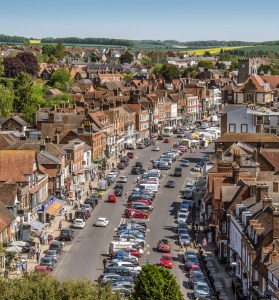 The theme of today’s Civic Service is ‘Schools and Education’. A quick inventory amongst the congregation present this morning shows that most of us are or have been in some way educated in Marlborough. Looking at the Mayors present from other Wiltshire towns, I am sure that if we would have done the same in your Town or Parish, the result would have been the same: certainly here in Wiltshire, education is at the heart of the community.
When we think about education, probably most of us rightly think of schools, children and young people first. And that is one of the reasons why it is so encouraging that a large part of the Mayor’s charities this year benefit the young people in our Town. But, education doesn’t end when you leave school: we continue to learn, and for that matter to teach, all our lives.
The English word ‘education’ finds its root in the Latin word that means ‘to mould’ or ‘to train’ (educare). It is also related to the word that means ‘to lead out’ or ‘to bring forth’ (educere). So, when we think about education, we have two famous images: that of a potter moulding clay into a certain form, and of a midwife bringing forth a new-born child.
Imagine for a moment a potter, a sculptor, working on a piece of art. It starts with a raw block of clay or other material, and slowly it is shaped, it is formed into something beautiful; something precious. Over days, weeks and months, the artist invests a lot of him or herself into the material, and I suggest that this is what it gives the final piece of art its beauty: the love and the care that go into it.
Love and care are words that apply to the image of a midwife as well. There is something incredibly precious about each new child being born. So I suspect that although midwives may deliver over hundreds of babies in the course of their lives, each time there is a sense of wonder that inspires in us a desire to love and care.
Inspired by these two images, this is what I would like to suggest this morning education is about. It is not just about imparting knowledge from teacher to pupils, but it is the process in which through love and care, both teacher and pupil are formed. It is not a one-way process, but a forming of a relationship, in which people learn from each other. So no wonder that education is at the heart of community life.
This thought brings us then to this morning’s reading: the parable of the Good Samaritan. First of all, because it shows us what kind of a teacher Jesus is like. ‘An expert in the law stood up to test Jesus. “Teacher”, he asked, “what must I do to inherit eternal life?” Jesus himself was by many regarded as a teacher. People would come to teachers like him to find answers, to find advice.
However, Jesus normally answers, not giving a straightforward and simple answer, but replying with a question or telling a story, a parable, as he does here as well. He tries to make people see that they have the answer themselves already: a good example of education as ‘bringing forth’.
Then Jesus tells then the familiar story of the Good Samaritan. A man is lying in a ditch. Beaten up and stripped of his clothes. Half dead. The first two people who walk past are a priest and a Levite. People of high standing within society, dignitaries. Leaders, teachers themselves.
Instead of helping the man, however, they leave him. We don’t hear why. They may have felt too busy. They may have been scared. Or they may have felt he wasn’t worth being helped, probably looking not looking very appealing in that state.
The third person who walks past is a Samaritan. A traveller himself, like the man who was robbed. When he sees him lying in the ditch, he takes pity on him, and takes care of him. He looks after the man’s wounds, and then takes him to an inn to rest and to get better. This is, Jesus says, what it means to be a neighbour. And then Jesus says to the person who asked the question: ‘Go and do likewise’. This is what God wants us to do, to be good neighbours. To look out for each other, not matter who it is, and to care for one another.
That collective responsibility, I think brings us back to the theme of this service ‘Schools and Education’. As members of this community here in Marlborough, we need to look out for each other. It doesn’t matter whether we are the Mayor, a Town Councillor, a teacher, a parent or a pupil: whoever we are, we have to do what the Samaritan did: notice the person who needs us and help them.
Because before we can help, we need to notice. We need to keep our eyes open to those who may need our help. And that is not just the homeless people, or those who are sick: everyone needs someone at some point, whether you’re young or old, rich or poor.
So, we come back to where we started: that education, that community life is about love and care, and hence about relationships. It is by no means a one-way process, but it is reciprocal: together we learn and grow. You cannot do this on your own.
Jesus said to the person who asked the question ‘Go and do likewise’. And that is what we may be able to take away from today ‘Go and do likewise’. Go and be good neighbours to each other. Learn, live and love together. That is how we continue to grow as individuals, and as a community.
The more we do this, in the image of the sculptor, the more we will be able to see the beauty in each other and the beauty of our community life. It is then that we realise that in loving each other, we ourselves are loved to. In caring for one another, we are cared for too. That, to me, is the essence of human life, and the essence of the Christian faith.
‘Go and do likewise’.
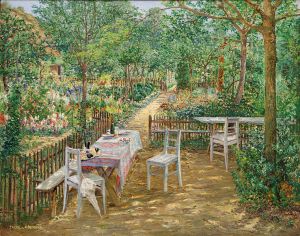 It it a lovely sunny Sunday afternoon in June. I wonder what the first thing is that comes to mind you will be doing? I suspect some may immediately think of gardening – weeds always seem to grow faster than anything else. Others will have in mind a nice roast lunch with family or friends. Or maybe sit in the garden and read a good novel, or go on a walk. The first thing that comes to my mind are cycling and BBQ-ing!
 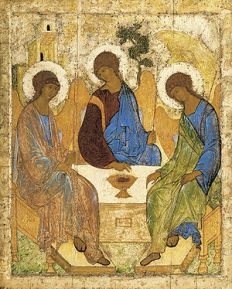 The first question one might ask today is ‘Why have a Sunday dedicated to celebrating a doctrine, to celebrating a Church teaching?’ It is much more straightforward to understand why we celebrate Christmas, Easter and Pentecost, commemorating specific events, moments in history, or at least our salvation history. However, why would we celebrate a concept, even a concept that is nowhere to be found in the Bible explicitly, as it was only first mentioned by the Church Fathers in the late 2nd century?
 Today is the Sunday between Ascension Day and Pentecost. It is interesting, I think, how in the UK Ascension Day does not really feature, whereas on the Continent in most countries it still is a public holiday.
 It has been estimated during those thirty years of the Troubles that over 3,500 people were killed. That number made me realise that the scale of the recent violence in London is not very different, with already over fifty murders in the first three months of this year. Whereas in Northern Ireland, the conflict has been very much associated with Christianity, the violence in London seems to be of a different nature. This, I suspect, is not unrelated to the fact that Christianity in Ireland is still much more prominent than it is in our capital city nowadays.
 Without wanting to make any judgment, I think that some of you who are reading this may be old enough to remember one of the BBC’s most famous April Fool’s Day hoaxes, reporting the remarkable
  In contrast to Advent, it seems to me, where every Sunday we light one more candle until it is Christmas, in Lent, the mood gets darker and darker as we approach the end of the season. Indeed, Good Friday still stands between us and Easter at this point. Personally, I find myself often conflicted in these last weeks before Easter: part of me is eagerly anticipating the joy of the Easter celebration, whilst another part of me knows there is still more work to be done before I am ready to appreciate the fullness of Jesus’ Resurrection. I almost feel like I’m watching a solar eclipse on the horizon: the shadow of Good Friday slowly moving to cover the glory of Easter, only to be seen again in all its fullness when the shadow has passed.
 This fourth Sunday of Lent, half-way through the austere season leading up to Easter, is also Mothering Sunday. Traditionally it was a day when children, daughters mainly, were given a day off to visit their mother and family. However, the ‘mothering’ part of this Sunday has its roots in a tradition that didn’t have much to do with our biological mothers.
 This morning we hear what I assume are two quite familiar passages: The Ten Commandments and the cleansing of the temple. I would like to suggest this morning that both these readings teach us something about who God is, and hence, can give us an insight in who we are, and who we are meant to be.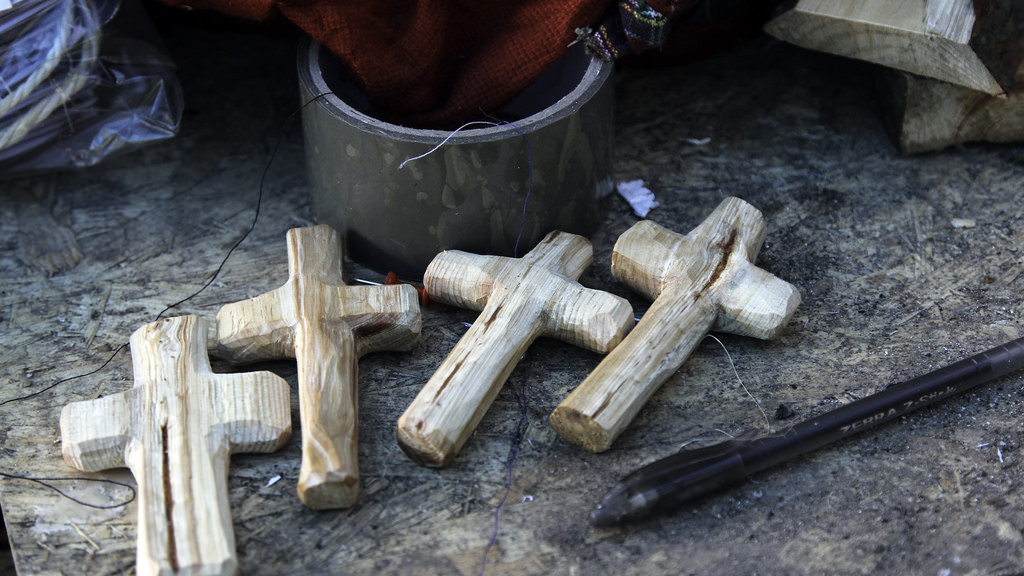
 Discovering Life